Revised May 2026
John Smith runs a plumbing business in Dallas. His website clearly states “John Smith, Plumber, 25 years experience, serves Dallas Metro” at the top of his homepage. However, he has not yet learned the value of schema markup and structured data.
Google understands what that means. Modern search algorithms can parse natural language, infer relationships, and extract entities from unstructured text. Google probably knows John is a plumber, likely serves Dallas, and might have 25 years of experience.
Probably. Likely. Might.
That uncertainty is the gap. It costs real businesses real conversions every day.
I’ve implemented Local Business schema on sites where the content was already clear, well-written, and technically sound. The traffic didn’t spike. What changed was eligibility: for rich snippets, for voice assistant responses, for AI Overview inclusions. Impressions stayed flat. Clicks went up. The content hadn’t changed. The declarations had.
I apply the same principle to this site. OGV runs Article schema on every post and FAQ schema on posts where the content supports it. Both are validated through Google’s Rich Results testing tool. The implementation I am describing here is the same process running on the pages you are reading.
Search engines infer. Structured data declares.
That distinction is the entire argument.
What Google Infers vs. What It Is Willing to Act On
When Google’s algorithm encounters John’s homepage, it doesn’t struggle to identify that he’s a plumber. Contextual understanding has improved dramatically. The algorithm can parse “plumber” as a profession, “Dallas Metro” as a service area, and “25 years” as a credential marker.
But there’s a difference between understanding with 85% confidence and acting on 100% confidence.
Without structured data, Google makes educated guesses:
- John is probably a plumber (high confidence)
- He likely serves Dallas Metro (medium confidence)
- The 25 years probably refers to experience (medium confidence)
- His business is probably located in Dallas (low confidence; he could serve the area without being based there)
- He might offer emergency services (low confidence; the page mentions it, but is that a core offering or a footnote?)
With structured data, every inference becomes a declaration:
- John IS a plumber (declared via LocalBusiness schema)
- He SERVES Dallas, Irving, Plano, Richardson (declared via areaServed)
- He HAS 25 years of experience (declared via yearsInOperation)
- His business IS LOCATED at a specific Dallas address (declared via address)
- He OFFERS emergency plumbing as a primary service (declared via Service schema)
The difference is not whether Google understands. It is whether Google is confident enough to act on that understanding and where it chooses to act.
How Inference Uncertainty Costs You the 2 AM Search
At 2 AM on a Tuesday, someone’s water heater fails. They ask their phone: “Find an emergency plumber near me who’s available now.”
Google’s voice assistant needs to provide an answer. Not a list. A specific recommendation.
John offers 24/7 emergency service. His website says so. But without structured data explicitly declaring his hours and service availability, the assistant has to infer from text patterns. That inference carries uncertainty.
Meanwhile, John’s competitor has LocalBusiness schema with hours marked “24/7” and Service schema with emergency availability explicitly declared. The assistant responds with the competitor’s name and number.
The search engine understood both businesses. It acted on the one with explicit declarations.
The gap between understood and acted upon is where structured data earns its place in a serious SEO strategy. The same dynamic shows up across every modern search surface, not just voice.
How Each Search Surface Handles the Infer vs. Declare Gap
The surfaces where this gap matters most for a small business:
Traditional Search Results
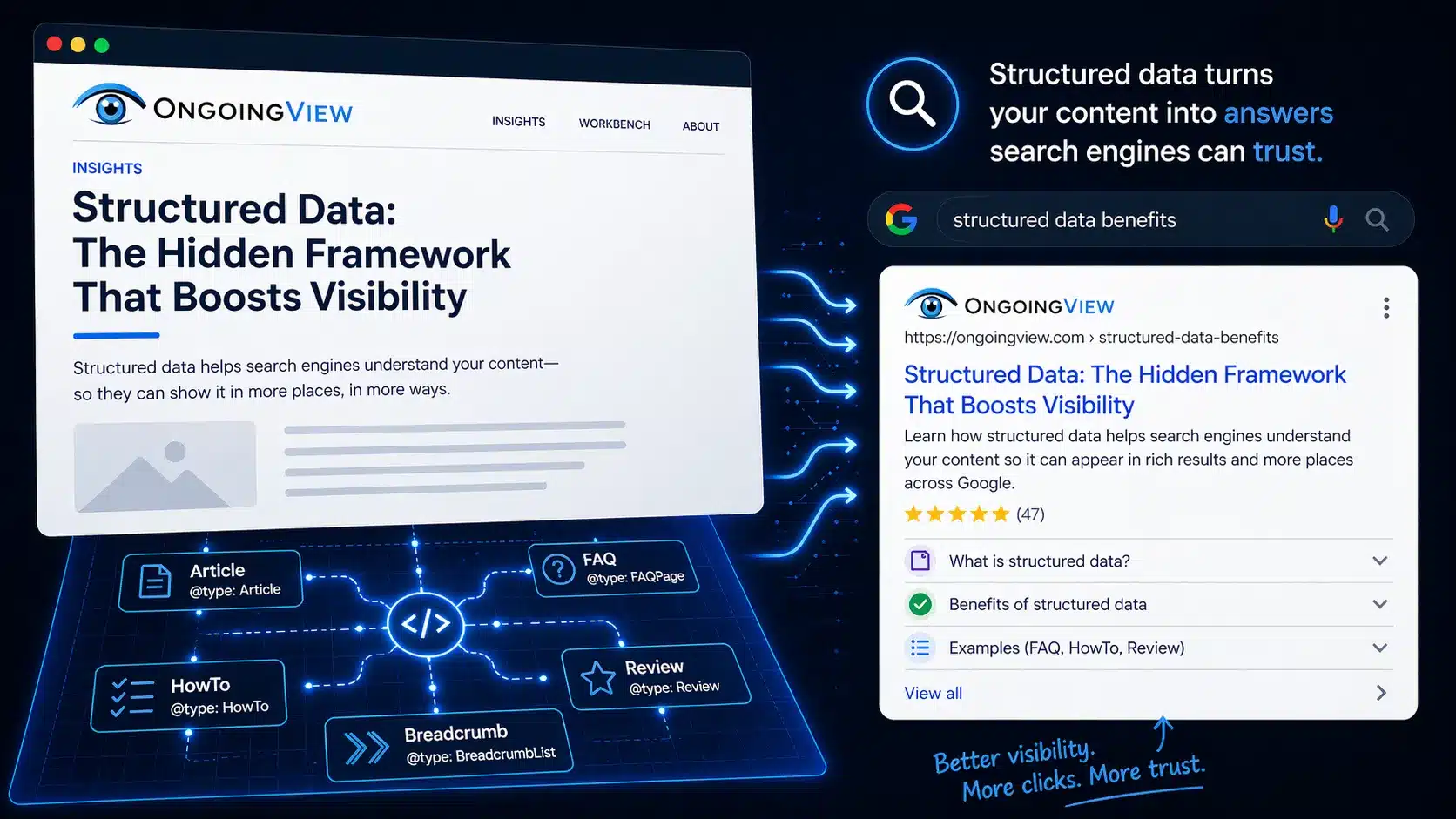
Review schema is required to display star ratings. John’s 4.8-star rating exists in testimonial text scattered across his site. Without Review schema aggregating that data, Google may understand he has satisfied customers but won’t display the stars. His competitor with schema gets the visual advantage in a list where every other signal is equal.
AI Overviews
AI Overviews draw from multiple signals, but high-confidence declared facts carry more weight in how they surface and attribute content. When Google’s AI answers “best emergency plumbers in Dallas,” businesses with explicit structured declarations have a structural advantage. John’s business appears as “Smith Plumbing Services (25 years experience, 4.8 stars, 24/7 availability)” because those facts are declared, not inferred. Businesses that show up in AI Overviews aren’t always the highest-ranking pages. They’re the ones whose data Google can cite with the most confidence.
Local Pack and Maps
Structured address, service area, and hours data determine local pack inclusion and display. Without declared service area boundaries, Google infers coverage from content. That inference can exclude John from searches two miles from his physical address.
Voice Assistants
“Probably open” doesn’t become a spoken recommendation. John’s hours appear in his footer and on his contact page, but without LocalBusiness schema declaring specific operating hours, the assistant defaults to competitors who made explicit declarations.
The sophistication of modern search doesn’t reduce the value of structured data. It increases it. More surfaces means more decision points, and each decision point favors explicit declarations over inferred ones.
This is also why human-centric SEO and technical structure are not competing priorities. The technical layer makes your content eligible. The human layer makes it worth clicking.
The Three Functions Structured Data Serves That Inference Cannot Replicate
This is the strategic layer most implementations miss. Structured data doesn’t just help search engines understand your content. It serves three distinct functions:
01 / Precision
Eliminates the gap between what Google infers and what you actually offer.
“Probably serves this area” becomes “definitely serves Dallas, Irving, Plano, and Richardson.” When an AI Overview cites your business, precision determines whether you get mentioned accurately or not at all.
02 / Priority
Signals which information matters most.
You’re declaring “emergency plumbing is a core service” rather than letting Google decide whether a brief mention on your services page is central or peripheral. Schema markup is how you control what gets emphasized across search features.
03 / Eligibility
Opens access to search features that require structured data to participate.
Rich results, knowledge panels, AI Overview inclusions, voice assistant responses. Google might understand your content perfectly but won’t display it in these formats without proper markup.
These three functions are independent. A business can have excellent precision (accurate declarations) but poor priority (declaring everything equally, so nothing stands out). Getting all three right is what separates schema implementation that moves metrics from schema implementation that just passes a validator.
For small business operators managing this without a dev team, the distance between passing a validator and actually moving metrics is usually a strategic gap, not a technical one. The mechanism is almost always in content targeting or site architecture, not the schema configuration itself.
The Implementation Sequence: Three Weeks, Prioritized by Impact

John doesn’t add structured data because Google can’t understand his website. He adds it because explicit declarations create competitive advantages that inferred data can’t match, and because the implementation is shorter than most other SEO work.
Week 1
LocalBusiness Schema
Name, address, phone, hours, service area. This drives the majority of local SEO value: local pack eligibility, voice assistant responses, map integrations.
Validate: Run through Google’s Rich Results Test before moving to Week 2. If it doesn’t pass, nothing downstream will perform correctly.
Week 2
Service Schema
Service type, availability, areas served. Google knows he offers this service from reading his pages. Declaring it makes him eligible for service-specific searches and AI Overview inclusions when Google needs high-confidence data about emergency availability.
Validate: Schema Markup Validator after implementation.
Week 3
Review Schema
Google can see customer testimonials scattered across his site, but Review schema aggregates that data and converts it into star ratings in search results. The visual difference between “probably has good reviews” and “4.8 stars” in a results list determines which listing gets the click.
Validate: Schema Markup Validator after implementation. Review schema has strict formatting requirements that are easy to get wrong.
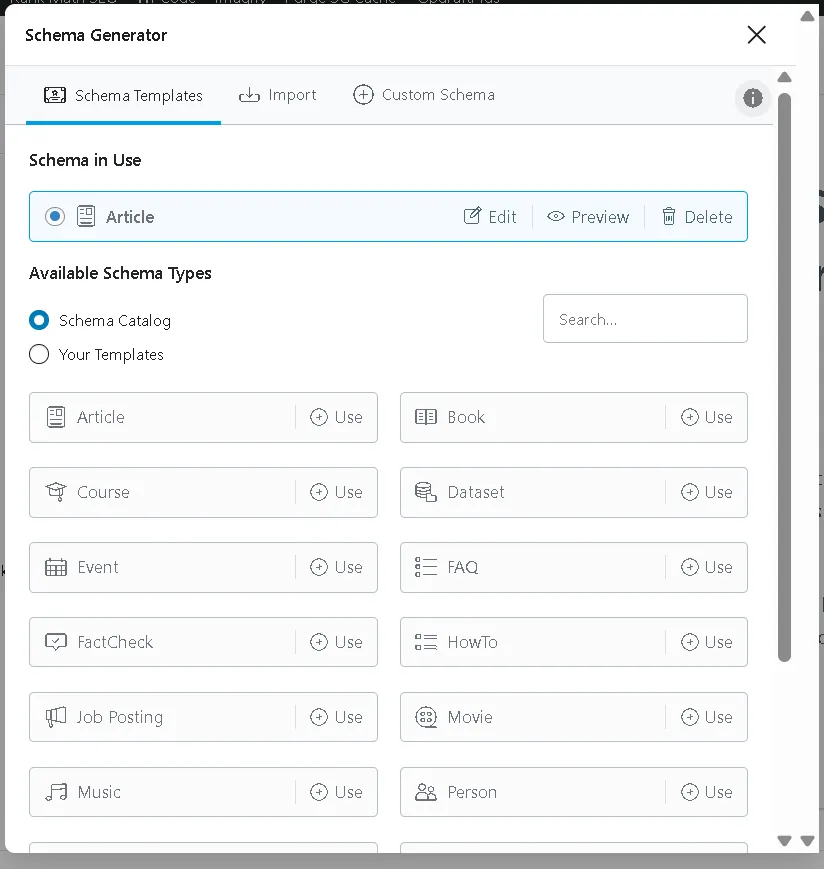
If you’re managing this on WordPress, Rank Math handles schema implementation at the post and page level without requiring custom code. I cover how the setup works and where it falls short in my Rank Math SEO plugin review.
Why Early Schema Implementation Compounds
Most businesses assume that if their website is clear to humans, it’s clear to search engines. They’re right about the first part. Modern algorithms are sophisticated enough to understand natural language content.
But understanding is not the same as acting.
When someone searches “emergency plumber Richardson Texas,” Google understands dozens of plumbing businesses serve that area. Some have explicit Service schema declaring emergency services. Some have strong natural language content mentioning emergency work. Some have both.
The businesses with structured data get preferential treatment in rich results, local pack placement, and AI-generated summaries. Not because Google can’t understand the others, but because explicit declarations create confidence that inference can’t match.
Business operators who implement schema correctly typically see click-through rates improve meaningfully at stable impression levels. The rich snippet display (hours, ratings, service area, phone number) does work that the title and meta description alone can’t. Someone comparing three plumbers sees one listing with all of that context and two without. The click goes where the declaration is clearest.
That advantage compounds over time. Every new search surface Google introduces creates a new decision point that favors declared data over inferred data. Schema implementation done now is infrastructure for search features that don’t exist yet.
Most of the competitive advantage available in search right now is sitting in the gap between businesses that have implemented structured data and those that have not. The businesses on the wrong side of that gap are not losing because they have worse services or weaker content. They are losing because they are asking search engines to infer what their competitors have declared. That gap closes the moment you implement. The question is whether you do it before or after your competitors do.
Search engines will infer based on your content. Structured data declares what your content is. That distinction determines how your business shows up in search results.
Frequently Asked Questions
What is schema markup and why does it matter for SEO?
Schema markup is structured data added to your website that tells search engines exactly what your content is, rather than asking them to infer it. It matters because Google acts differently on declared information than inferred information. Pages with accurate schema are eligible for rich results, AI Overview inclusions, and voice search responses that pages without schema cannot access, regardless of content quality.
Does schema markup directly improve Google rankings?
Not directly. Schema does not move your position in standard organic results on its own. What it does is improve how your listing appears once it ranks and opens eligibility for search features that standard rankings do not reach. Better listing appearance typically improves click-through rate at the same position, which is often more valuable than a small ranking gain.
What schema types should a small business implement first?
LocalBusiness schema first. It covers name, address, phone, hours, and service area and drives the majority of local SEO value including local pack eligibility and voice search responses. Service schema second, declaring specific offerings and availability. Review schema third, which converts existing testimonials into star ratings in search results. That order is prioritized by impact, not complexity.
How do I add schema markup to a WordPress site without coding?
Rank Math handles schema at the post and page level through a visual interface inside the WordPress editor. You select the schema type, fill in the relevant fields, and the plugin outputs the structured data automatically. The free version covers Article, FAQ, How-To, LocalBusiness, and several other types. Rank Math Pro removes the one-schema-per-post limit, which matters when content needs multiple schema types simultaneously.
Will schema markup help my content appear in AI Overviews?
It improves eligibility. AI Overviews draw from high-confidence declared facts. A business with LocalBusiness schema that explicitly declares service area, hours, and specializations is more likely to be cited accurately in an AI-generated answer than one whose information has to be inferred from page text. Schema does not guarantee inclusion but removes one of the primary reasons for exclusion.