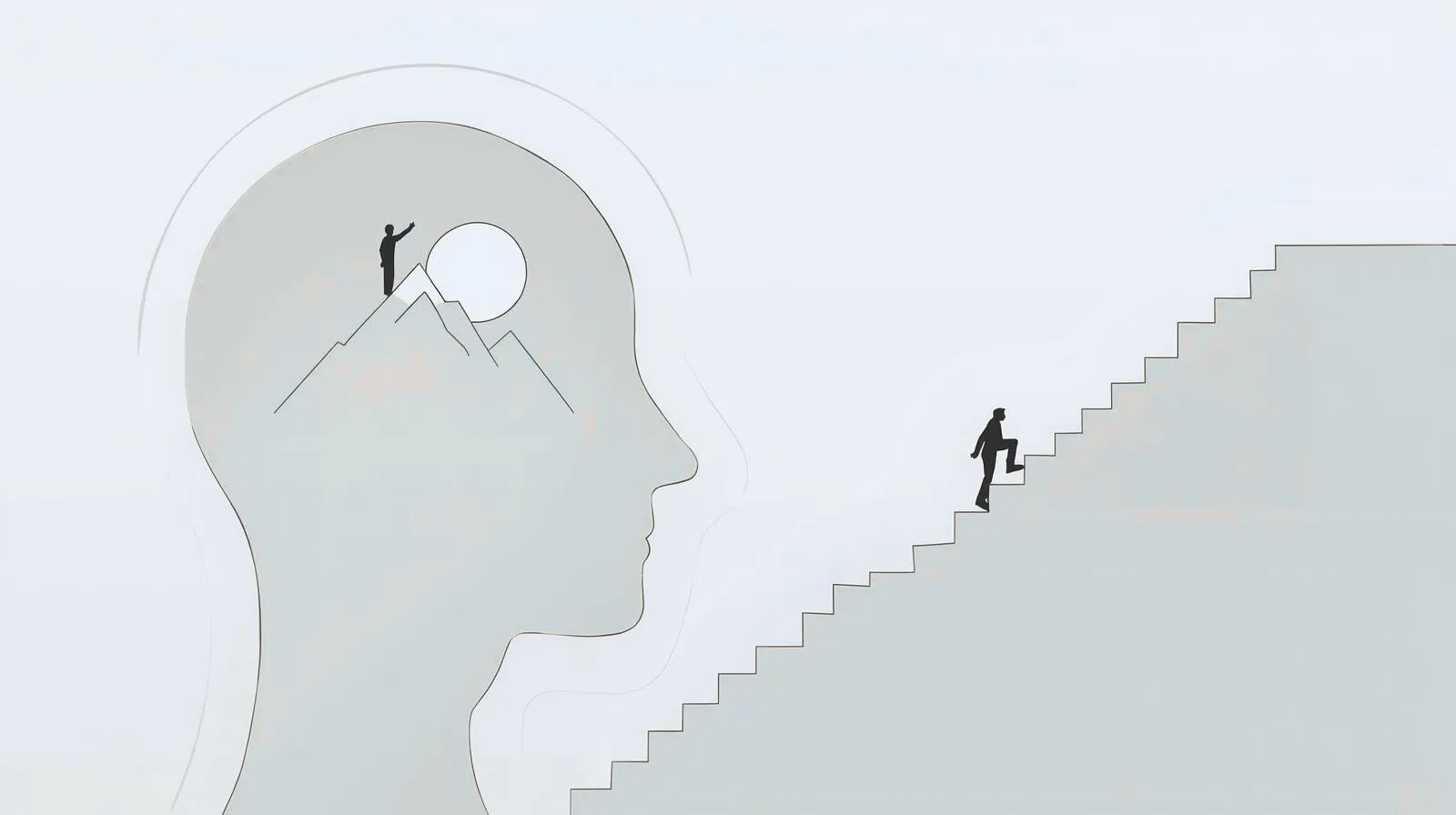
When you have something that needs doing and you cannot seem to begin, the problem is usually not the work itself.
Sometimes you know exactly what to do and still do not move. Other times the goal is clear but the path into it is not, and the whole thing feels like too much to take on at once. Both versions stall in the same place and feel similar from inside.
Every trip, every task, every journey, whether it is 10 steps or 10,000, is always preceded by one. Before the second step exists, the first one has to happen. That is not a motivational phrase. It is the only way anything moves forward. And it is harder to act on than it sounds.
What the Loop Actually Looks Like
The loop is staying busy on something without actually moving toward it. It disguises itself as work. You are occupied. You are focused. You are doing something connected to the goal. But you are not moving toward it.
The difference is whether what you are doing is a step toward the goal or whether the step has become the goal itself. Revising something already written. Reorganizing something already organized. Moving things around in a space you were supposed to be clearing. The activity is real. The progress is not.
What makes the loop difficult to catch is that the brain does not experience it as avoidance. It registers as work. The discomfort of the actual start has been postponed, and something that feels productive has taken its place.
Why the Loop Exists
New starts are treated by the brain as uncertainty events. A task already in motion has data attached to it: you know what it costs, how it feels, what comes next. A new start has none of that. The brain’s threat response treats ambiguity the way it treats risk, and resistance fires before you have done anything at all.
The loop is not a flaw in this system. It is the system working as designed, routing available energy toward activity it has evidence for. The brain knows how to revise a document. It knows how to reorganize a shelf. It does not yet know what the new start costs. So it defaults to what it already knows, and frames that substitution as staying productive.
Chemistry has a term for this threshold: activation energy. The minimum input required to start a reaction. Once past it, the reaction sustains itself. The brain follows the same principle. The initial cost of entry is almost always the highest cost in any task. Once in motion, the brain has evidence. Resistance drops. But it does not drop before you start. It drops because you started.
Waiting to feel ready is the wrong sequence. Readiness is a result of starting, not a prerequisite for it.
The Goal Is Never the Problem. The Entry Point Is.
The same stall appears across very different kinds of goals. The pattern looks the same whether the goal is personal or professional, physical or digital.
A spare room or basement that has become overflow storage feels impossible to begin because the goal is “clean it out,” and the brain cannot process that as an action. It gets thought about. It does not get started.
The digital version works the same way. A computer full of folders inside folders, files with three versions of “final” in the name. The goal is clear. The first move is not.
Professionally, the pattern shows up with anything that has a visible output and a real cost to being wrong. Someone deciding what to name their business can spend weeks in research without committing to a direction. Not because they cannot make the decision. Because naming it makes it real and evaluable, and the brain treats that exposure as a cost it is not sure you can afford yet.
Finding a new job follows the same structure. The goal is clear, but “find a new job” is not an action. It is a project. The people who move on it quickly are not usually more motivated. They found the first step: update one line, send one message, open one tab. Everything else follows from there.
People who recognize this pattern, whether in themselves or in someone they work with, tend to approach stuck situations differently. The question shifts from what is wrong with the person to what the actual first step is. That shift changes the whole conversation.
Breaking It Down Changes the Calculation
Setting individual goals that build on each other is a direct response to how the brain decides whether to engage with something. It is not a productivity trick. It is working with the architecture instead of against it.
When you break “clean the room” into “clear the floor between the door and the window,” the brain now has something it can evaluate as a start. When you break “launch the business” into “write ten words that describe what this thing is,” the same shift happens. Each individual goal is mostly inconsequential on its own. Together they form the path.
When I am stalled on something for this site, the question I come back to is not why I am not working on it. It is what the first checkable action actually is. Naming it specifically is usually enough to start.
The goal does not shrink. The entry point does.
Ten steps always begins with one. So does five hundred.
A Practical Sequence for Breaking the Stall
This is not about working harder. It is about reducing the activation energy of beginning.
1. Determine whether you are moving or looping
Ask what the last completed, checkable thing was. If you cannot name one from the last hour of work, you are likely substituting activity for progress. Naming this is a navigation point, not a judgment.
2. Name the first step, not the goal
The goal stays the goal. What changes is the immediate target. It needs to be specific enough that you can tell whether you did it or you did not. “Work on the project” is not a step. “Write the opening paragraph” is. “Clean the garage” is not a step. “Move everything off the left wall into one pile” is.
3. Start within 60 seconds of naming it
The window between deciding to start and actually starting is where most resistance rebuilds. The decision and the first action need to be as close together as possible.
4. Name the next step before stopping the current one
The transition between steps is where the entry cost resets. Name what comes next before you pause. Before you close the document, write the first line of the next section. Before you leave the room, identify which pile you are tackling next. The specifics do not matter. What matters is that the next step exists before the current one ends.
The Mindset Shift Comes From the Practice
Here is where the mindset piece belongs. It is not separate from the skill. It is what happens after the practice builds enough evidence.
When you break goals into individual steps consistently enough, something changes in how you approach the next one. Not because it got easier. Because you stopped waiting to feel ready and started trusting that the first step would generate what you needed to continue.
That trust is connected to the story you carry about who you are, and whether you follow through. That story does not change through intention. It changes through evidence.
The gap between knowing what to do and actually doing it closes through action, not through more preparation. Recognizing the pattern is the first step in working with it rather than against it.
The 21-Day Discipline Challenge
Get your free 21-Day Discipline Challenge workbook. A simple way to push yourself into consistent actions that build sustainable momentum.
Frequently Asked Questions About Starting
Why do I know what I need to do but still cannot make myself start?
Knowing and starting are processed differently. Knowing is cognitive. Starting is behavioral, and the behavioral system stalls when the beginning feels high-cost and ambiguous. The gap between knowing and doing is real, and it closes through action, not through more thinking. The brain needs evidence from the task, and that evidence only exists on the other side of starting.
Is this the same as procrastination?
Related but not identical. Procrastination usually implies avoiding something unpleasant. This pattern applies equally to things you genuinely want to do. The loop shows up most often with work that matters, because the stakes of being evaluated on it feel higher. It is not about not wanting to do something. It is about the brain’s response to uncertainty at the start, regardless of how much you want to do it.
What if I do not know where to start because the goal is too big?
That is the most common version of this. When a goal is too large to process as a single action, the brain stalls at the entrance. The fix is to stop treating the goal as the first step and find the smallest specific action that moves in the right direction. The goal does not shrink. The entry point does.
Does starting get easier over time?
With practice, yes. What changes is your relationship to the feeling of resistance. When you have enough evidence that starting has always been survivable and the discomfort has always been temporary, your response shifts. You start anyway, not because it feels easy but because you trust the pattern. That trust is built through repetition, not through insight alone.
What is the difference between useful preparation and avoiding starting?
Preparation is a step toward the goal. Avoidance is when the preparation has become the goal. A useful check: what is the last specific thing you completed? If you have been occupied for an hour and cannot name one, you are likely in the loop. Being busy with something related to the goal is not the same as moving toward it.